


How to Identify Real Moissanite vs Fake Moissanite: Expert Guide

You see a brilliant stone flashing rainbow colours under the jewellery store lights. The seller calls it premium moissanite. The price looks attractive, the sparkle is impressive, and at first glance, everything seems perfect.
But is the stone actually moissanite?
Learning how to identify real moissanite vs fake moissanite has become increasingly important for jewellery buyers. Glass, cubic zirconia and other diamond simulants can sometimes be presented misleadingly, especially when a buyer relies only on sparkle.
The surprising truth is that sparkle alone cannot confirm moissanite authenticity.
Real moissanite has distinctive optical and physical characteristics. Once you understand its brilliance, fire, double refraction, durability and professional testing behaviour, identifying suspicious stones becomes much easier.
This complete guide explains how to tell if moissanite is real, which home tests are useful, which popular tests are unreliable and when professional gemstone verification is the safest option.
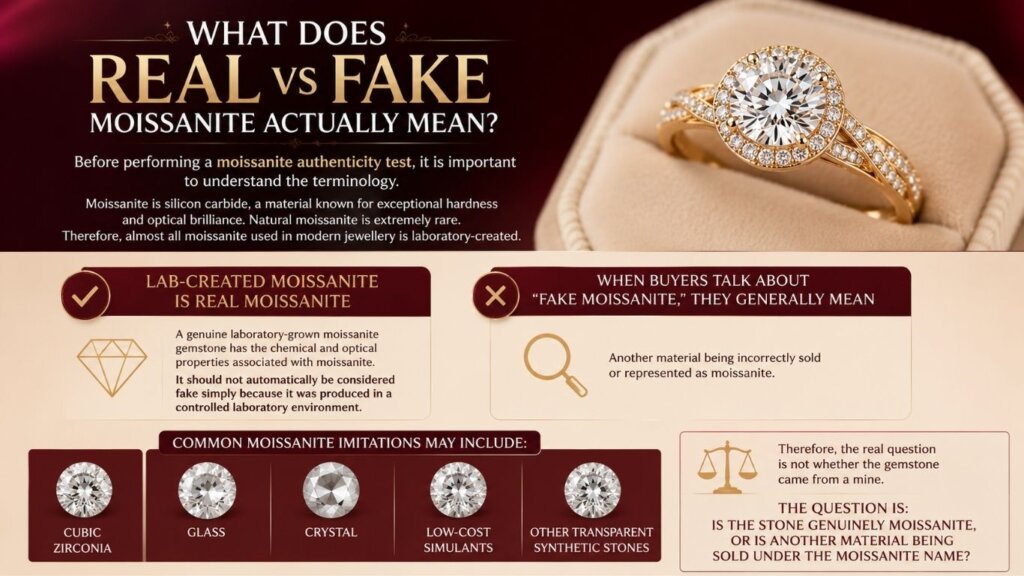
What Does Real Moissanite vs Fake Moissanite Mean?
Real moissanite used in modern jewellery is generally laboratory-created silicon carbide.
Moissanite is a distinct gemstone material. It is not a type of diamond and should not be described as a natural diamond or lab-grown diamond.
When buyers search for “fake moissanite,” they are often referring to another material being sold or represented as moissanite.
Possible substitutes may include:
- Cubic zirconia
- Glass
- Crystal
- Low-cost synthetic simulants
- Other colourless gemstones
- Misrepresented jewellery stones
The key issue is therefore not whether laboratory-created moissanite is “real.” Genuine lab-created moissanite is still moissanite when its material is silicon carbide.
The real question is: Does the stone being sold actually have the properties of moissanite?
Quick Answer: How Can You Tell If Moissanite Is Real?
Real moissanite can be identified by examining its strong brilliance and fire, double refraction under magnification, high durability and response to suitable gemstone testing equipment. For reliable verification, combine visual inspection with a moissanite-capable tester and professional gemological examination.
No single casual home trick should be treated as absolute proof.
Why Identifying Genuine Moissanite Is Important
Imagine buying an engagement ring advertised as high-quality moissanite. You pay for the gemstone, setting and craftsmanship.
Months later, a jeweller examines the ring and tells you the centre stone appears to be cubic zirconia.
The problem is not simply that cubic zirconia is inexpensive. The real issue is that you paid for one gemstone and received another.
Knowing how to check real moissanite helps you:
- Make informed jewellery purchases
- Avoid misleading gemstone descriptions
- Compare prices more accurately
- Understand the stone you actually own
- Select jewellery with realistic durability expectations
- Ask sellers better questions
- Verify important purchases before finalising them
For engagement rings, custom jewellery and premium moissanite pieces, gemstone identity matters.


Real Moissanite Identification: Understanding the Stone First
Before testing moissanite, it helps to understand what makes the gemstone distinctive.
1. Moissanite Is Silicon Carbide
Moissanite is composed of silicon carbide.
Modern gem-quality moissanite is typically created under controlled laboratory conditions. The finished gemstone is cut and polished to maximise brilliance.
This chemical and crystal structure gives moissanite properties that are noticeably different from common simulants such as cubic zirconia and glass.
2. Moissanite Has Exceptional Brilliance
Brilliance refers broadly to the white light returned from a faceted gemstone.
A well-cut moissanite can look extremely bright. In jewellery store lighting, the stone may appear lively and highly reflective.
However, brightness is not an authenticity certificate.
A polished cubic zirconia can also look attractive, especially when new. Visual inspection should therefore involve more than asking, “Does it sparkle?”
3. Moissanite Shows Strong Fire
Fire is the separation of white light into spectral colours.
Moissanite is known for producing noticeable rainbow flashes. Under spotlights, sunlight or certain LED lighting, these colourful flashes can become particularly obvious.
This is one reason some buyers immediately notice a visual difference between moissanite and diamond.
Strong fire can be a useful clue, but it is not a standalone genuine moissanite test.
4. Moissanite Is Highly Durable
Moissanite is a hard gemstone suitable for frequent wear.
This makes it popular for:
- Engagement rings
- Solitaire rings
- Earrings
- Pendants
- Bracelets
- Everyday jewellery
Glass and some low-cost substitutes do not share the same hardness or long-term wear characteristics.
A suspicious stone showing significant surface abrasion may require closer inspection. However, visible damage alone cannot identify the material because jewellery can be damaged in several ways.
5. Moissanite Can Show Double Refraction
One of the most discussed characteristics in moissanite identification is double refraction.
In simple terms, light travelling through certain directions of the gemstone can produce a doubling effect.
When examined through a jeweller’s loupe or microscope from an appropriate angle, facet junctions may appear doubled.
This characteristic can provide an important identification clue for trained observers.
How to Identify Real Moissanite vs Fake Moissanite: Step-by-Step Guide
The safest approach is to use several observations rather than depending on one viral internet test.
Step 1: Check the Stone’s Overall Appearance
Start with a clean gemstone.
Oil, soap, lotion and dust can change the way any stone reflects light. A dirty genuine moissanite may appear dull, while a freshly polished simulant may look impressive.
After appropriate jewellery cleaning, observe the stone under:
- Normal indoor light
- Daylight
- Spotlighting
- Diffused white light
Rotate the jewellery slowly.
Look at the consistency of the brilliance and coloured flashes.
What Real Moissanite May Look Like
Genuine moissanite often appears:
- Very bright
- Highly brilliant
- Rich in spectral or rainbow flashes
- Crisp when well cut
- Lively during movement
What a Suspicious Simulant May Look Like
Depending on the material, a substitute may appear:
- Glassy
- Flat
- Excessively transparent without crisp light return
- Dull after surface wear
- Abraded around facet edges
Remember: appearance provides clues, not conclusive proof.
Step 2: Observe the Fire and Rainbow Flashes
Move the stone under a concentrated light source.
Moissanite is famous for its fire. You may notice flashes of:
- Red
- Orange
- Yellow
- Green
- Blue
The effect can be particularly noticeable in larger stones.
Cubic zirconia can also display colourful light, which is why the rainbow test is often misunderstood online.
Myth: Rainbow Sparkle Automatically Means Moissanite
False.
A colourful flash is not a chemical test. Gemstone cut, lighting and material properties all influence appearance.
Use fire as one part of a broader moissanite authenticity test.
Step 3: Examine the Stone With a 10x Loupe
A 10x jeweller’s loupe can reveal details that are difficult to see with the naked eye.
Inspect:
- Facet junctions
- Surface condition
- Polish
- Chips
- Abrasion
- Internal characteristics
Try viewing through the crown of the stone while focusing on facet junctions deeper inside.
A trained observer may detect doubling associated with moissanite’s optical properties.
Why Loupe Examination Matters
Suppose two round colourless stones look almost identical from across a counter.
Under magnification, one stone shows heavily abraded facet edges and a different visual character. The second shows crisp facet junctions and optical doubling.
The loupe has not necessarily completed the identification, but it has provided valuable evidence.
For expensive jewellery, these small observations matter.
Step 4: Look for Double Refraction
Double refraction is one of the more useful expert clues when identifying moissanite.
When the stone is viewed from suitable directions under magnification, some facet junctions may appear doubled.
Think of looking at a single line and seeing a faint second line close to it.
However, this test requires experience.
The cut, viewing direction and observer’s focus can affect what is visible.
If you are a first-time jewellery buyer, do not reject a stone simply because you cannot personally see doubling.
A gemologist or experienced jewellery professional may examine it more effectively.
Step 5: Use a Suitable Moissanite Tester
Gemstone testing instruments can provide much stronger evidence than visual tricks.
Traditional thermal diamond testers created confusion because moissanite’s thermal behaviour can cause certain testers to react in ways associated with diamond.
This is why you may hear stories about moissanite “passing a diamond tester.”
Modern testing devices may use additional properties to help separate diamond and moissanite.
Will Moissanite Pass a Diamond Tester?
Some thermal conductivity testers may react to moissanite similarly to diamond. Therefore, a basic diamond tester alone may not reliably distinguish the two. A tester designed to differentiate moissanite from diamond should be used.
This is an important buying lesson.
If a seller touches a pen-style tester to a stone and says, “See, it is genuine,” ask what the instrument actually tests.
A tester result is only meaningful when you understand the device’s capabilities.
Step 6: Check the Jewellery and Stone Documentation
Documentation should match the product being sold.
Review available information for:
- Gemstone identity
- Shape
- Measurements
- Weight details
- Colour grade, if applicable
- Clarity information, if applicable
- Report or certificate number
- Issuing laboratory or grading organisation
Do not assume that a printed card automatically proves authenticity.
Check whether the report details correspond with the actual gemstone.
Important Certificate Verification Tip
If a certificate or grading report includes an online verification feature, use the issuing organisation’s official verification system.
Compare the report number and stone details.
Be cautious when:
- The seller refuses to show documentation promised in the listing
- Measurements do not match
- The report number cannot be verified where verification is offered
- Product descriptions are inconsistent
- The seller calls moissanite a “lab-grown diamond”
Transparent gemstone terminology is a major trust signal.
Step 7: Compare the Stone With Cubic Zirconia
Cubic zirconia is one of the materials buyers commonly confuse with moissanite.
Real Moissanite vs Cubic Zirconia
| Feature | Moissanite | Cubic Zirconia |
|---|---|---|
| Material | Silicon carbide | Zirconium dioxide |
| Brilliance | Very high | Bright but visually different |
| Fire | Strong | Can show colourful flashes |
| Hardness | Higher | Lower than moissanite |
| Durability | Excellent for frequent wear | More prone to wear over time |
| Double Refraction | Can be observed in suitable directions | Singly refractive |
| Professional Testing | Identifiable with appropriate tools | Different testing characteristics |
The biggest mistake is assuming every brilliant colourless stone is moissanite.
Professional testing focuses on measurable gemstone properties rather than marketing descriptions.
Step 8: Compare the Stone With Glass
Glass imitations may look bright in carefully controlled photographs.
In person, differences may become more obvious.
Glass is generally softer and may show:
- Surface scratches
- Abraded facet edges
- Less crisp faceting
- A glassy visual appearance
- Different optical behaviour
Under magnification, some glass materials may also contain features such as gas bubbles.
However, do not intentionally scratch the gemstone to test it.
Step 9: Avoid Destructive Scratch Tests
One of the worst online recommendations is: “Scratch the stone and see what happens.”
Do not do this.
A hardness test should not be casually performed on finished jewellery.
You may damage:
- The gemstone
- The setting
- The polish
- Another surface used for testing
The fact that moissanite is hard does not mean destructive testing is a smart authenticity method.
Professional gemologists have safer identification techniques.
Step 10: Get Professional Gemological Verification
For a high-value purchase, professional examination is the most reliable approach.
A trained gemologist can combine:
- Magnification
- Optical examination
- Thermal testing
- Electrical conductivity testing
- Advanced gemological instruments
- Knowledge of gemstone properties
This multi-test approach reduces the risk of misidentification.
If you are buying an important moissanite engagement ring or expensive custom jewellery, independent verification can provide additional confidence.
Benefits of Buying Genuine Moissanite
Why does genuine moissanite matter when other colourless simulants can also sparkle?
Excellent Brilliance
Moissanite offers intense light return when properly cut.
Its bright appearance makes it highly attractive for centre stones and statement jewellery.
Strong Fire
Buyers who love colourful flashes often prefer moissanite’s visual character.
Under movement, the stone can create a dramatic display of spectral colours.
High Durability
Moissanite’s hardness makes it suitable for jewellery designed for frequent wear.
Proper care is still important, particularly because the metal setting can scratch, bend or become damaged even when the centre stone is durable.
Attractive Diamond Alternative
Moissanite provides a distinct option for buyers seeking a colourless or near-colourless brilliant gemstone.
It should be purchased as moissanite, not as a “fake diamond.”
Clear gemstone identity allows buyers to appreciate the material for its own characteristics.
Wide Range of Jewellery Options
Genuine moissanite is available in popular shapes including:
- Round
- Oval
- Cushion
- Emerald
- Pear
- Radiant
- Marquise
- Princess
This variety allows buyers to choose a stone based on personal style and jewellery design.
Common Moissanite Myths and Truths
Myth 1: If It Passes a Diamond Tester, It Is Diamond
Truth: Some basic thermal testers may react to moissanite. A basic tester result should not be treated as complete gemstone identification.
Myth 2: All Rainbow Sparkle Means Moissanite
Truth: Other stones can display colourful flashes. Fire is a visual clue, not definitive proof.
Myth 3: Lab-Created Moissanite Is Fake Moissanite
Truth: Gem-quality moissanite produced in a laboratory is genuine moissanite when the material is silicon carbide.
Myth 4: You Can Always Identify Moissanite With the Naked Eye
Truth: Experienced professionals may recognise visual clues, but appearance alone is not always enough for conclusive identification.
Myth 5: Real Moissanite Never Needs Cleaning
Truth: Oils, lotions, soap residue and everyday dirt can affect a stone’s appearance. Jewellery requires appropriate care and cleaning.
Myth 6: A Certificate Card Always Guarantees Authenticity
Truth: Documentation should be examined and verified when possible. The report details must correspond to the actual gemstone.
Myth 7: The Scratch Test Is the Best Home Test
Truth: Destructive testing can damage jewellery and is unnecessary. Non-destructive gemological tests are safer.
Expert Tips for Identifying Original Moissanite
Use Multiple Tests
Never depend on one observation.
A stronger identification process combines:
- Visual examination
- Magnification
- Optical characteristics
- Appropriate electronic testing
- Documentation review
The more consistent the evidence, the stronger the identification.
Ask the Seller Direct Questions
Before buying, ask:
- Is the stone moissanite or a different simulant?
- Is the stone laboratory-created silicon carbide?
- Is any gemstone report included?
- Can the report details be verified?
- What is the return policy?
- Can I have the gemstone independently examined?
A reputable seller should provide clear product information.
Be Careful With Misleading Terminology
Watch for vague phrases such as:
- Diamond-like stone
- Premium American diamond
- Diamond moissanite
- Lab diamond moissanite
- Diamond replica
- Luxury crystal diamond
These phrases do not automatically identify the gemstone.
The product description should clearly state what material is being sold.
Inspect the Stone Before the Return Period Ends
If you purchase moissanite online, check the jewellery promptly.
Review:
- Stone identity documentation
- Measurements
- Visible condition
- Setting security
- Product description
- Invoice details
If professional verification is important to you, arrange it while the seller’s return or dispute period remains active.
Real-Life Example: The Sparkle Trap
Consider a buyer named Riya searching for a moissanite solitaire ring.
She finds two online listings.
The first listing repeatedly says “diamond shine stone” and “premium luxury brilliance.” It does not clearly identify the gemstone material.
The second listing states that the centre stone is laboratory-created moissanite, provides stone measurements and clearly describes the jewellery specifications.
The first ring looks brighter in the edited product photos.
Which listing provides better information?
The second.
Professional jewellery buying is not about selecting the brightest photograph. Lighting, camera settings and image processing can dramatically influence gemstone appearance.
Clear product information is more valuable than exaggerated marketing claims.
Real Moissanite vs Fake Moissanite: Quick Comparison
| Identification Factor | Genuine Moissanite | Possible Fake or Substitute |
| Material | Silicon carbide | Glass, CZ or another material |
| Fire | Strong spectral fire | Varies by material |
| Brilliance | Very high | Varies |
| Double Refraction | Characteristic optical clue | May be absent |
| Durability | High | Depends on substitute |
| Basic Diamond Tester | May create confusion | Result varies |
| Moissanite-Specific Testing | Identifiable | Different response |
| Documentation | May include matching stone details | May be vague or misleading |
How to Buy Genuine Moissanite With Confidence
Before clicking “Buy Now,” use this simple buyer checklist.
Moissanite Buying Checklist
- Confirm the stone is clearly described as moissanite.
- Check the shape, measurements and jewellery specifications.
- Ask about gemstone documentation.
- Verify report details when online verification is available.
- Review the seller’s return and exchange policy.
- Avoid relying only on product photographs.
- Ask whether independent inspection is allowed.
- Keep your invoice and gemstone documentation.
- Use appropriate professional testing for high-value purchases.
- Compare the price with similar moissanite jewellery.
Price alone cannot confirm authenticity.
An expensive stone can be misrepresented, and a competitively priced stone can still be genuine.
Focus on evidence.
FAQ: How to Identify Real Moissanite vs Fake Moissanite
1. How Can You Tell If Moissanite Is Real?
Real moissanite can be identified through its optical and physical properties. Strong brilliance, noticeable fire and double refraction may provide clues. Appropriate gemstone testing instruments and professional gemological examination offer more reliable verification than appearance alone.
2. How Do You Test Moissanite at Home?
At home, clean the stone and inspect it under different lighting conditions. Use a 10x loupe to examine facet junctions and look for possible optical doubling. Review the gemstone documentation carefully. Avoid destructive scratch tests. For confirmation, use professional testing.
3. What Does Fake Moissanite Look Like?
There is no single appearance for fake moissanite because different materials can be substituted. Glass may appear softer or more glassy, while cubic zirconia can be bright and colourful. This is why visual appearance alone cannot conclusively confirm gemstone identity.
4. Will Fake Moissanite Pass a Diamond Tester?
The result depends on the material and the type of tester. Basic thermal diamond testers can also react to genuine moissanite, creating confusion between diamond and moissanite. Use a suitable tester designed for gemstone differentiation.
5. Does Real Moissanite Scratch Easily?
Moissanite is a hard and durable gemstone, so it is relatively resistant to scratching during normal wear. However, jewellery should still be handled carefully because the metal setting can become scratched or damaged.
6. How Can You Identify Original Moissanite?
Check the gemstone’s brilliance, fire and optical properties under magnification. Review available documentation and use appropriate testing equipment. A professional gemologist can provide a more reliable identification by combining several tests.
7. Does Real Moissanite Get Cloudy?
The gemstone itself is durable, but surface buildup from oil, soap, cosmetics and dirt can reduce its apparent sparkle. Appropriate cleaning may restore brilliance. Persistent appearance changes should be examined by a jewellery professional.
8. Can a Jeweller Tell If Moissanite Is Real?
An experienced jeweller or gemologist with suitable testing tools may identify moissanite. For important purchases, choose a professional with gemological knowledge and instruments capable of separating moissanite from diamond and other simulants.
9. What Stones Can Be Confused With Moissanite?
Cubic zirconia, glass and other colourless simulants may sometimes be confused with moissanite by inexperienced buyers. Diamond and moissanite can also create confusion when only a basic thermal tester is used.
10. Is Moissanite Easy to Identify?
Moissanite can often be identified by a trained professional using magnification and suitable testing equipment. For consumers, visual inspection may provide useful clues, but professional verification is recommended when gemstone identity significantly affects the purchase decision.
Conclusion
The best approach is to combine visual inspection, magnification, certification, and, when necessary, professional gemological testing. Always purchase from a trusted jeweller who provides transparent product information and authentic certification, ensuring you receive exactly what you are paying for.
At Shraddha Shree Gems, we are committed to offering certified, genuine moissanite jewellery along with expert guidance to help you choose the perfect gemstone. Every piece is carefully selected for quality, craftsmanship, and authenticity, so you can shop with complete confidence.
Whether you’re buying your first moissanite ring, upgrading your jewellery collection, or searching for the perfect gift, choosing a reputable seller makes all the difference. Explore our collection of premium moissanite jewellery and experience the beauty, brilliance, and value of authentic gemstones backed by trusted expertise.
For More Information Contact Us –
+91 9711449703 or Visit Our Shop