


Burma Ruby: The King of Gemstones from the Mines of Myanmar

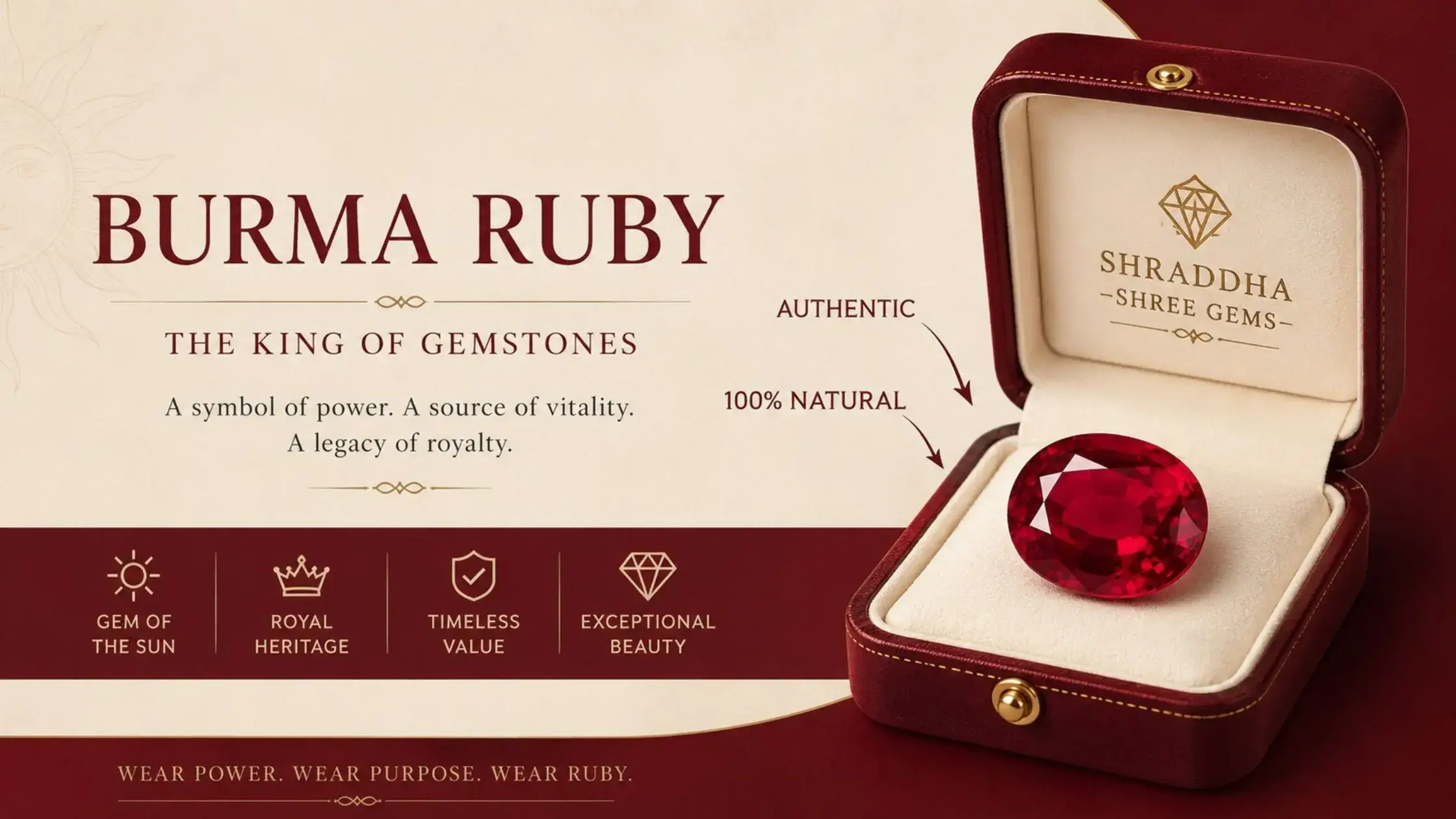
There is a reason the ancient Sanskrit texts called Ruby Ratnaraj — the King of Gemstones. No other stone commands attention the way a fine Burma Ruby does. Its red is not just a color. It is a statement. Deep, vivid, and alive — like a drop of pigeon’s blood caught in crystal. For thousands of years, kings, emperors, warriors, and saints have sought this gem above all others. And at the center of that story, always, is Burma — present-day Myanmar — the source of the world’s most legendary rubies.
At ShraddhashreeGems, we carry Burma Ruby with the deepest respect for what it represents. Each stone we source comes from the ancient mines of Myanmar, carrying with it a history, a spiritual power, and a beauty that no other origin can replicate. Whether you seek it for its royal beauty, its astrological connection to the Sun, or its status as a timeless investment — this guide gives you everything you need to know.
What Is a Ruby?
Ruby belongs to the mineral family corundum (Al₂O₃) — the same family as sapphire. What separates ruby from all other corundum is its red color. Trace amounts of chromium replace aluminum atoms within the crystal structure. This chromium not only creates the red color but also causes ruby to fluoresce — to glow with an inner fire — under both daylight and ultraviolet light. The result is a gem that seems lit from within.
Ruby ranks 9 on the Mohs hardness scale, second only to diamond. This makes it one of the most durable gemstones on earth. You can wear it daily without fear of damage. Furthermore, its refractive index gives it a brilliance that rivals even the finest diamonds when cut well.
In the gem world, the term “ruby” applies only to red corundum that meets a minimum color saturation threshold. Below that threshold, the stone becomes a pink sapphire. This distinction matters enormously — both for value and for astrological use.
Why Burma? The Mogok Valley and Its Legacy
When gemologists and collectors speak of the finest rubies in the world, one name rises above all others — Mogok. The Mogok Valley in northern Myanmar is an ancient volcanic region where geological conditions created something truly extraordinary. Marble-hosted deposits, rich in chromium and low in iron, produce rubies with a color and fluorescence that no other deposit on earth has matched.
Burma has supplied the world’s finest rubies for over a thousand years. Ancient Chinese emperors traded for them. Mughal kings adorned their thrones with them. European royalty set them in their crowns. Today, fine unheated Burma rubies remain among the most valuable gemstones per carat in the entire world — regularly outpricing even the finest diamonds at major auction houses.
So what makes Burma Ruby truly irreplaceable?
- Pigeon’s blood color — The most prized rubies in the world carry this description. It refers to a pure, vivid red with a slight blue undertone — neither too orange nor too purple. Mogok produces this color more consistently than any other source on earth.
- Natural fluorescence — Burma rubies fluoresce strongly under ultraviolet light. This is because Mogok’s marble deposits are low in iron, which would otherwise suppress fluorescence. As a result, Burma rubies glow with an almost magical inner fire that stones from other origins simply cannot match.
- Unheated specimens — A meaningful percentage of Burma rubies reach the market without heat treatment. These natural, unheated stones are extraordinarily rare and command prices that reflect their rarity.
- Historical and investment prestige — At every major international auction — Christie’s, Sotheby’s, Bonhams — the records for ruby prices per carat are held by Burma origin stones. That tells you everything about where the world’s top collectors place their trust.
Burma Ruby in Vedic Astrology: The Gem of the Sun
In Jyotish (Vedic astrology), the Sun (Surya) is the king of all planets. It governs the soul, identity, self-confidence, leadership, authority, health, and vitality. A strong Sun in a birth chart produces individuals who are confident, dignified, and respected. A weak or afflicted Sun, on the other hand, can bring self-doubt, poor health, lack of recognition, and troubled relationships with authority and father figures.
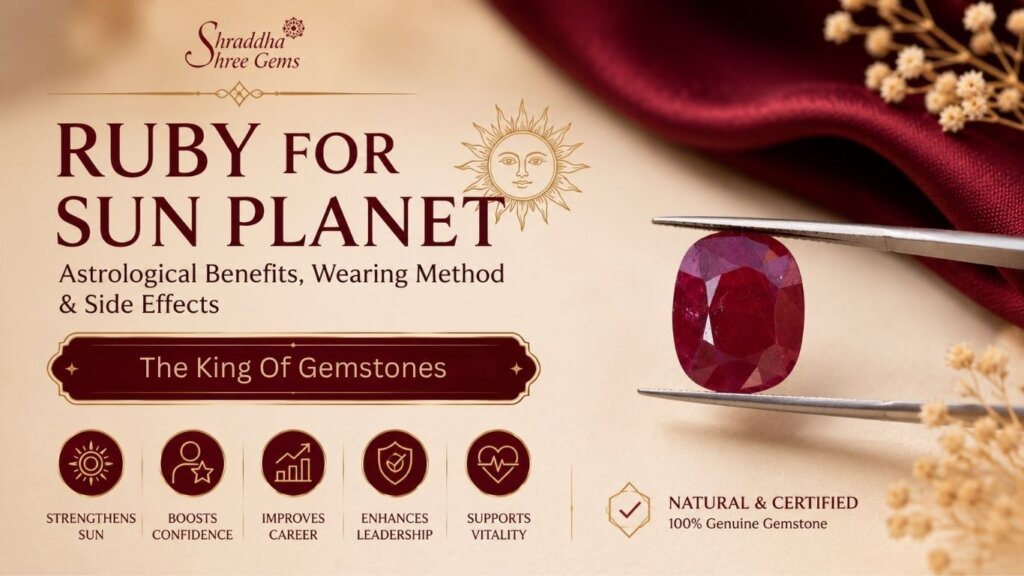
Manik — Ruby — is the Sun’s primary gemstone. Wearing a natural Burma Ruby strengthens the Sun’s energy in your chart. Consequently, it brings the Sun’s most positive qualities into your daily life.
Astrological Benefits of Burma Ruby
Wearing a genuine Burma Ruby traditionally delivers the following benefits:
- Confidence and self-worth — The Sun rules personal identity. Therefore, Ruby helps its wearer develop a stronger sense of self, natural authority, and inner courage.
- Leadership and recognition — Ruby is the stone of kings for a reason. It attracts recognition, respect, and positions of leadership in both professional and social life.
- Vitality and physical health — The Sun governs the heart, eyes, spine, and overall vitality. Ruby supports these areas and brings sustained physical energy and strength.
- Success in career and government — Jupiter and Sun together govern authority structures. As a result, Ruby is especially powerful for those in government service, politics, medicine, or senior leadership roles.
- Stronger father relationships — The Sun is the significator (karaka) of the father in Vedic astrology. Wearing Ruby can improve your relationship with your father and strengthen paternal blessings in your life.
- Protection from enemies — Ancient Vedic texts describe Ruby as a protective stone. It shields its wearer from negative energy, envy, and those who wish harm.
- Spiritual clarity — The Sun represents the Atman — the soul. Wearing its gem deepens self-awareness and aligns the wearer with their true life purpose.
Who Should Wear Burma Ruby?
Ruby is most naturally suited to individuals with Leo (Simha) as their ascendant (lagna), since the Sun rules this sign. It also benefits those running the Sun’s Mahadasha or Antardasha in their Vimshottari Dasha cycle.
However, Ruby is a powerful stone that does not suit every chart. For example, it may not work well for Taurus, Libra, Capricorn, or Aquarius ascendants. Therefore, always consult a qualified Jyotish practitioner before wearing Ruby or any other planetary gemstone. At ShraddhashreeGems, we work closely with experienced astrologers who can assess your chart and guide you correctly.
How to Wear Burma Ruby — Traditional Guidelines
- Metal: Gold (preferred) — 22k or 18k
- Finger: Ring finger (Sun’s finger) of the right hand
- Day and time: Sunday morning, during Shukla Paksha (waxing moon phase), ideally in the first hour after sunrise
- Activation: First, place the ring in raw cow’s milk or Gangajal overnight. Then recite the Sun’s mantra — “Om Hraam Hreem Hraum Sah Suryaye Namah” — 108 times before wearing
- Minimum weight: Traditionally 3 carats or above for astrological results, though your astrologer may recommend a specific weight based on your body weight and chart
The 4Cs of Burma Ruby: What Drives Value
1. Color — Everything Begins Here
Color is the single most important value factor in ruby. The finest Burma rubies display what the trade calls “pigeon’s blood red” — a pure, vivid red with a hint of blue, carrying strong saturation without being too dark or too light. This color is virtually exclusive to Mogok, Myanmar.
Color grading for ruby broadly falls into these categories:
- Pigeon’s Blood — The rarest and most valuable; vivid pure red with slight blue undertone
- Vivid Red — Slightly less saturated but still deeply desirable
- Medium Red — Good color, lower premium; widely available
- Pinkish Red or Orangish Red — Approaching the boundary of pink sapphire; significantly lower value
For Vedic astrological use, a rich, pure red without pink or orange undertones is strongly preferred. The deeper and purer the red, the more powerfully it is believed to carry the Sun’s energy.
2. Clarity
Unlike diamonds, rubies almost always carry inclusions. In fact, a completely inclusion-free ruby is so rare that its existence raises immediate questions of authenticity. The gem trade accepts inclusions in ruby far more readily than in sapphire or other gems. However, inclusions must not reach the surface or break the stone’s structural integrity.
The most common inclusions in Burma ruby are:
- Silk — Fine rutile needles that, when present in the right density, actually enhance the stone’s glow and velvetiness
- Fingerprints — Liquid-filled healing fractures that confirm natural origin
- Crystals — Mineral inclusions trapped during growth
Eye-clean Burma rubies of fine color are extraordinarily rare. When found, they command exceptional premiums.
3. Cut
Ruby cutters face a difficult challenge. They must balance three competing demands — maximizing color, preserving carat weight, and achieving symmetry. Oval and cushion cuts dominate the Burma ruby market. These cuts best display the gem’s color and natural fluorescence.
A well-cut ruby shows even color across its face with no dark “extinction” zones or washed-out “windows” in the center. So always examine the stone face-up under different light sources before buying.
4. Carat Weight
Fine Burma ruby above 1 carat with strong color is already rare. Above 2 carats, it becomes exceptional. Above 5 carats with pigeon’s blood color and no heat treatment, it enters the realm of the truly extraordinary — and prices reflect that accordingly. Moreover, Burma rubies do not follow a linear price increase with size. Instead, prices rise exponentially as carat weight increases, because large fine specimens are so scarce.

Natural vs. Heated Burma Ruby: A Critical Distinction
Heat treatment is extremely common in ruby. In fact, over 95% of rubies on the global market have undergone some form of heat treatment to improve color and reduce the visibility of inclusions. The trade accepts this widely. Nevertheless, all treatments must be disclosed.
For astrological purposes, however, a natural, unheated Burma Ruby is the gold standard. Vedic tradition teaches that heat treatment alters the stone’s cosmic energy. As a result, a treated stone weakens in its ability to transmit the Sun’s power to its wearer.
From an investment perspective as well, certified unheated Burma rubies command prices that are often 5 to 10 times higher than heated stones of comparable appearance. Furthermore, their appreciation over time is far more consistent and reliable.
There is also a more severe treatment to be aware of — lead glass filling. Some low-quality rubies are heavily fractured and filled with lead glass to improve their appearance. These stones carry almost no gemological or astrological value. Always insist on a certificate that specifically rules out fracture filling.
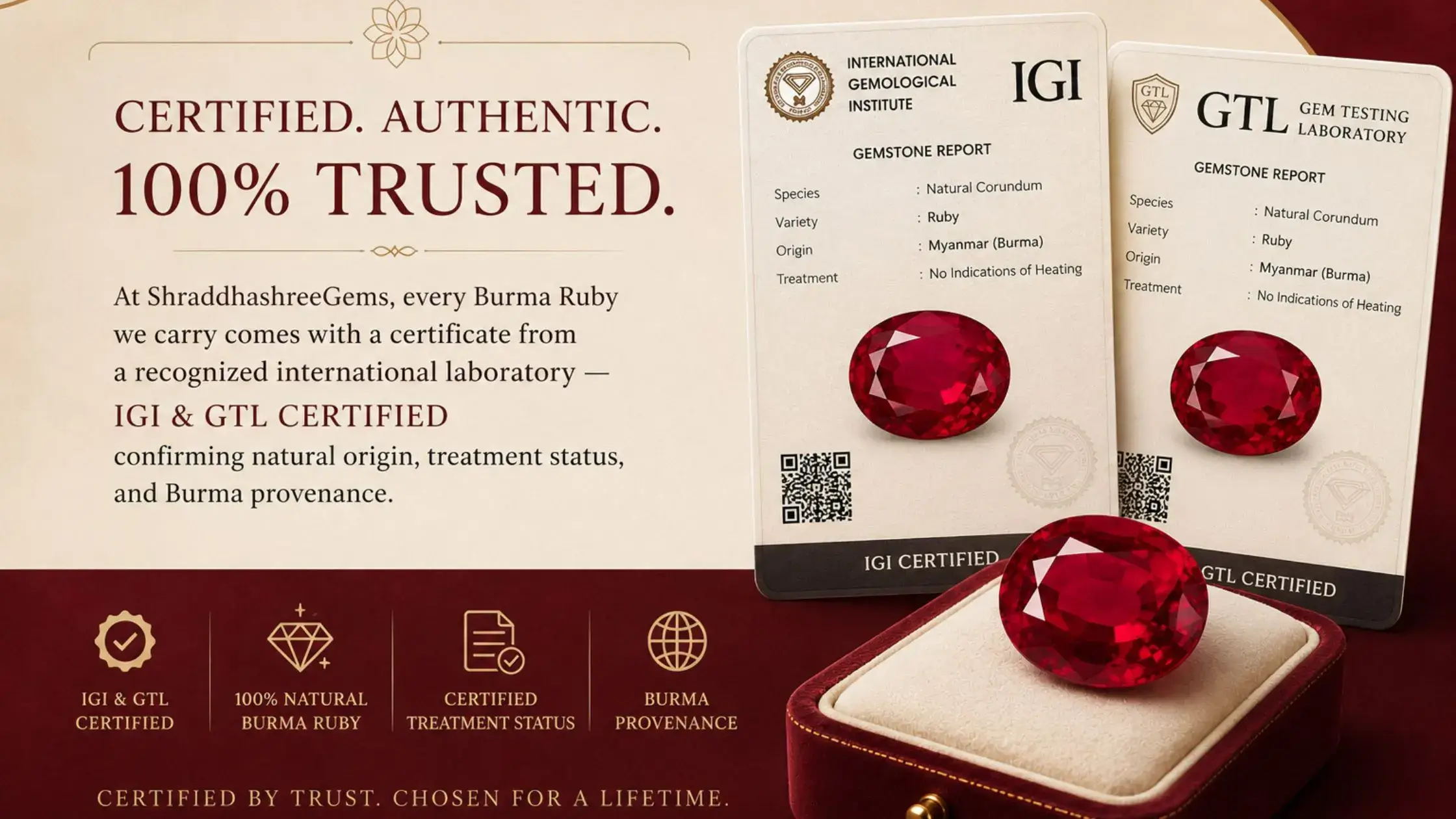
At ShraddhashreeGems, every Burma Ruby we carry comes with a certificate from a recognized international laboratory IGI & GTL Certified — confirming natural origin, treatment status, and Burma provenance.
How to Identify Genuine Burma Ruby
With ruby’s high value and strong demand, the market attracts many imitations. Therefore, every buyer must stay informed.
Common substitutes sold as Ruby:
- Red Spinel — Historically confused with ruby for centuries. It is a beautiful gem in its own right but carries different astrological properties and far lower value
- Red Garnet — Much softer, less brilliant, and astrologically distinct from ruby
- Red Glass — Worthless imitation; detectable immediately under a loupe
- Synthetic Ruby — Lab-grown corundum with identical optical properties but negligible astrological and investment value
- Heavily treated ruby — Glass-filled stones that look impressive but fall apart over time and hold almost no value
How to protect yourself:
- Always insist on a certificate from GIA, GRS, Gübelin, or SSEF
- Confirm the certificate specifically states “no indications of heating” for unheated stones
- Confirm Burma (Myanmar) origin on the certificate if provenance matters to you
- Buy only from established, reputable dealers with full transparency
- Be very cautious of rubies priced dramatically below market value
Caring for Your Burma Ruby
Ruby’s hardness of 9 on the Mohs scale makes it one of the most durable gemstones available. Still, proper care ensures it stays brilliant for generations.
- Cleaning: Use warm water, mild soap, and a soft brush. Rinse thoroughly and pat dry with a soft cloth.
- Ultrasonic cleaners: Safe for untreated, unfilled rubies. However, never use ultrasonic cleaning on glass-filled stones — it destroys the filling immediately.
- Storage: Store separately in a fabric-lined pouch or box. Keep away from diamonds, which can scratch almost any other gem.
- Avoid: Harsh chemicals, bleach, and sudden extreme temperature changes.
- Re-energizing: Many Vedic wearers cleanse their Ruby monthly. Soak it in raw milk or Gangajal overnight, then re-chant the Sun’s mantra 108 times the following morning.
Why Buy Burma Ruby from ShraddhashreeGems?
At ShraddhashreeGems, we source our Burma Rubies with the same care and respect we bring to every gemstone in our collection. Our direct relationships with trusted suppliers in Myanmar’s gem trade give us access to stones that rarely reach the open market.
Every Burma Ruby we offer is:
✔ 100% natural — we never carry synthetic or glass-filled stones ✔ Honestly labeled — heated and unheated status clearly disclosed for every stone ✔ Certified — by internationally recognized gemological laboratories ✔ Origin verified — Burma provenance confirmed where applicable ✔ Expert-supported — our team guides you on astrological suitability, ideal weight, gold setting, and wearing ritual
We understand that buying a Burma Ruby is rarely a casual decision. For many of our customers, it is an act of deep intention — a commitment to the Sun’s blessings, to personal growth, and to owning something truly extraordinary. We honor that intention with complete honesty and expertise.
Final Thoughts: The King of Gems Deserves a King’s Respect
Among all the gemstones the earth has ever produced, Burma Ruby stands alone. It is the stone that ancient cultures across Asia, the Middle East, and Europe all independently identified as the most precious of all. It is the gem that still breaks auction records. It is the stone that Vedic astrology places in the service of the Sun — the very soul of the cosmos.
So whether you seek its legendary beauty, its powerful astrological connection to the Sun, or its enduring investment value — a genuine, certified Burma Ruby from ShraddhashreeGems is far more than a gemstone. It is a piece of the earth’s greatest treasure, carried through millennia to find its place with you.
Explore our collection of natural Burma Rubies today. The King of Gemstones is waiting.