


Hessonite Garnet (Gomed): Rahu’s Most Powerful Gemstone from Ceylon and Africa

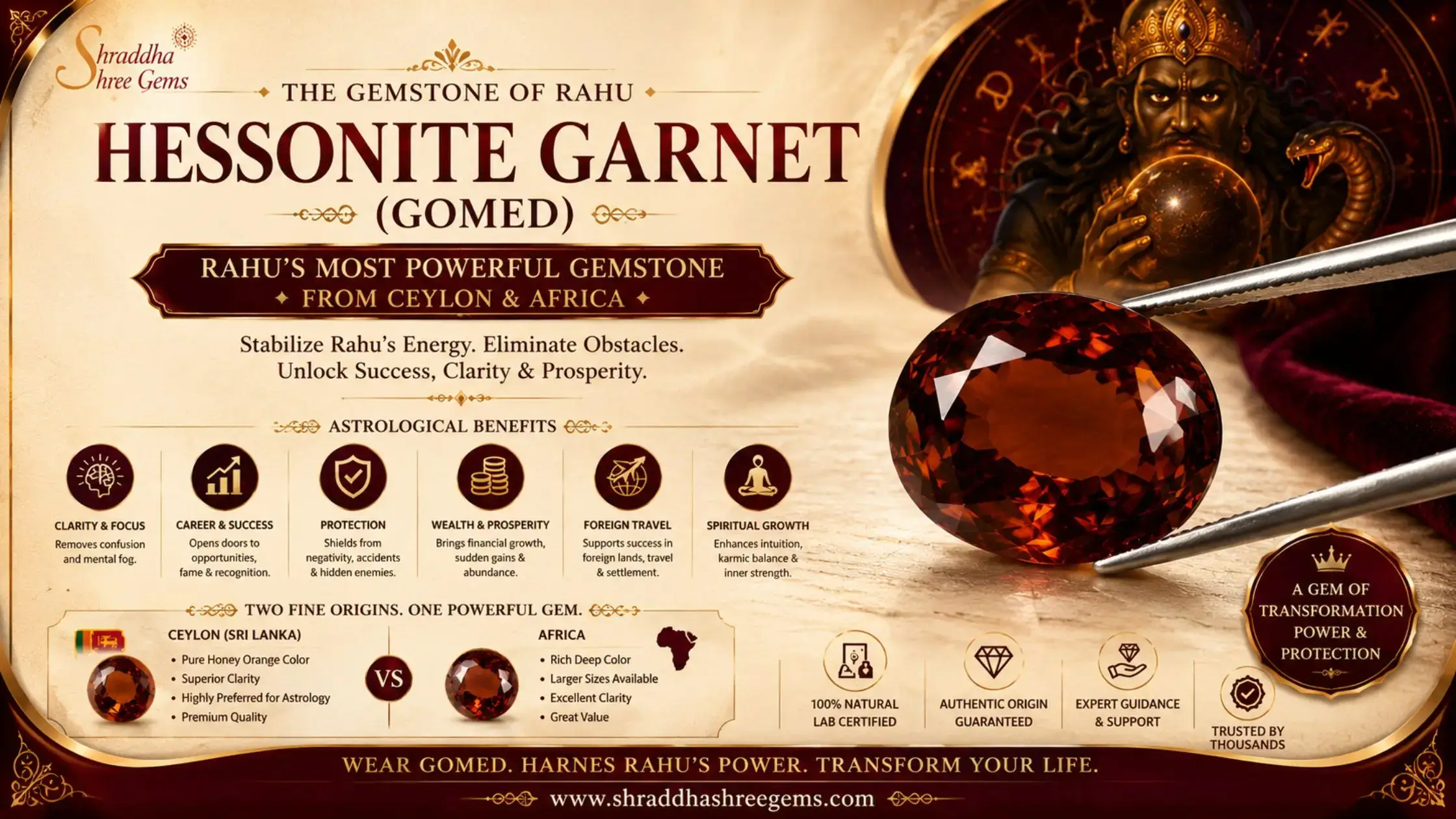
There is a gemstone in the Vedic tradition that carries a reputation unlike any other. It is not the most glamorous stone in the cabinet. It is not the rarest by weight or the most expensive by carat. Yet among Jyotish practitioners across India and the world, Hessonite Garnet — Gomed — commands a deep and genuine respect. Because this is the gemstone of Rahu — the shadow planet, the karmic disruptor, the force that can either unravel a life or accelerate it toward extraordinary success.
At ShraddhashreeGems, we source our Hessonite Garnet from two of the world’s most respected origins — Ceylon (Sri Lanka) and Africa. Each brings its own character, its own energy, and its own beauty to one of astrology’s most significant gems. This guide walks you through everything — the science, the astrology, the origins, and how to buy with complete confidence.
What Is Hessonite Garnet?
Hessonite is a variety of grossular garnet (Ca₃Al₂(SiO₄)₃). Its warm honey-orange to reddish-brown color comes from trace amounts of iron and manganese within its crystal structure. The name Hessonite comes from the Greek word hesson, meaning “inferior” — a historical reference to its lower hardness compared to other garnets. However, this name is misleading. In terms of beauty, astrological significance, and collector value, Hessonite is anything but inferior.
Hessonite ranks 6.5 to 7.5 on the Mohs hardness scale. This makes it suitable for pendants, earrings, and rings worn with reasonable care. Furthermore, its refractive index gives it a warm, glowing brilliance that is entirely its own — different from ruby or sapphire, but deeply attractive in its own right.
One of Hessonite’s most distinctive visual features is what gemologists call a “scotch in water” appearance — a swirling, heat-wave-like internal texture caused by varying densities within the crystal. This characteristic internal look actually helps identify genuine Hessonite from imitations.
The Two Origins: Ceylon vs African Hessonite
At ShraddhashreeGems, we carry Hessonite from both major sources. Each origin has its own strengths, and understanding the difference helps you make the right choice.
Ceylon Hessonite (Sri Lanka)
Sri Lanka has produced Hessonite Garnet for centuries from its famous alluvial gem gravels in the Ratnapura district. Ceylon Hessonite is widely regarded as the premier choice for Vedic astrological use. Here is why:
- Color excellence — Ceylon Hessonite displays a clean, warm honey-orange to golden-brown color. It is pure, even, and deeply attractive. Importantly, it lacks the muddy or overly dark tones sometimes seen in other origins.
- Superior clarity — Sri Lankan material consistently produces stones with fewer inclusions and better transparency. The characteristic “scotch in water” texture is present but subtle — giving the stone life without reducing its beauty.
- Astrological preference — Vedic astrology practitioners widely prefer Ceylon Hessonite above all other origins. Its color purity and natural energy are considered most aligned with Rahu’s cosmic frequency.
- Historical pedigree — Ceylon has supplied gemstones to the world for over two thousand years. Its Hessonite carries that legacy of trust and quality.
African Hessonite
Africa — particularly Tanzania, Madagascar, and Mali — produces Hessonite Garnet in significant quantities. African material has gained strong recognition in both the gem trade and the astrological community. Here is what sets it apart:
- Rich, deep color — African Hessonite often shows a deeper, more saturated reddish-orange to cinnamon brown color. Some collectors prefer this bolder palette.
- Larger sizes — African deposits tend to yield larger rough crystals. As a result, bigger faceted stones are more readily available from African sources.
- Strong clarity — African material also produces clean, transparent stones. The “scotch in water” texture is typically visible and well-defined.
- Accessible value — African Hessonite generally offers excellent quality at a more accessible price point compared to Ceylon material. This makes it a strong choice for those seeking astrological benefits without the premium of Ceylon origin.
In summary: Ceylon Hessonite is the gold standard for astrological use and carries a premium accordingly. African Hessonite offers excellent quality, bolder color, and larger sizes at a more accessible price. Both are genuine, powerful, and beautiful in their own right.
Hessonite Garnet in Vedic Astrology: The Gem of Rahu
In Jyotish (Vedic astrology), Rahu is one of the most complex and powerful forces in the entire planetary system. Rahu is a shadow planet — the north node of the Moon. It has no physical body, no sign of its own. Yet its influence on a birth chart can be more dramatic than almost any other planet.
Rahu governs ambition, obsession, illusion, foreign lands, technology, unconventional paths, sudden gains, and karmic lessons from past lives. A well-placed Rahu brings explosive success, fame, and rapid material advancement. An afflicted Rahu, however, brings confusion, addiction, deception, and obstacles that seem to come from nowhere.
Gomed — Hessonite Garnet — is Rahu’s primary gemstone. Wearing a natural Hessonite strengthens and stabilizes Rahu’s energy. As a result, it helps channel Rahu’s intense force toward positive outcomes rather than destructive ones.
Astrological Benefits of Hessonite Garnet (Gomed)
Wearing a genuine Hessonite Garnet traditionally brings the following benefits:
- Clarity through confusion — Rahu often creates mental fog, indecision, and illusion. Gomed cuts through this confusion. It sharpens focus and brings mental clarity to situations that previously felt overwhelming.
- Career acceleration — Rahu governs unconventional paths, technology, politics, and media. Therefore, Gomed is especially powerful for those in IT, film, politics, foreign trade, or any field that operates outside traditional structures.
- Protection from Rahu’s negative effects — During Rahu’s Mahadasha or Antardasha, life can feel chaotic and unpredictable. Wearing Gomed during this period helps stabilize the energy and reduce its more disruptive manifestations.
- Financial growth — Rahu is associated with sudden gains and material abundance. A well-directed Rahu, supported by its gem, opens unexpected doors to financial opportunity.
- Relief from fear and anxiety — Rahu’s affliction often manifests as irrational fears, phobias, and deep anxiety. Gomed is believed to calm these tendencies and bring groundedness to its wearer.
- Success in foreign lands — Rahu governs foreign travel, immigration, and international business. Consequently, Gomed is strongly recommended for those who work or live abroad.
- Legal protection — Ancient texts associate Rahu with legal disputes and hidden enemies. Gomed is believed to offer protection in legal matters and shield its wearer from deceit.

Who Should Wear Hessonite Garnet?
Hessonite is most strongly recommended for individuals currently running Rahu’s Mahadasha or Antardasha in their Vimshottari Dasha cycle. It also benefits those with Rahu placed prominently in their chart — particularly in the 1st, 5th, 9th, 10th, or 11th house.
However, Rahu is a deeply individual and complex force. Its gem must be chosen very carefully. Always consult a qualified Jyotish practitioner before wearing Gomed. At ShraddhashreeGems, we work alongside experienced astrologers who assess your full birth chart before making any recommendation.
How to Wear Hessonite Garnet — Traditional Guidelines
- Metal: Silver or Panchdhatu (five-metal alloy)
- Finger: Middle finger of the right hand
- Day and time: Saturday evening, during Shukla Paksha (waxing moon phase), at sunset
- Activation: First, place the ring in raw cow’s milk or Gangajal overnight. Then recite Rahu’s mantra — “Om Raam Rahave Namah” or “Om Bhram Bhreem Bhraum Sah Rahave Namah” — 108 times before wearing
- Minimum weight: Traditionally 5 to 6 carats or above for astrological results, though your astrologer may recommend a specific weight based on your body weight and chart
The 4Cs of Hessonite Garnet: Understanding Value
1. Color — Warm, Honey, and Pure
The finest Hessonite displays a rich honey-orange to golden-brown color — warm, even, and free of grey or muddy undertones. Ceylon material tends toward cleaner honey-orange tones. African material often shows deeper cinnamon or reddish-brown hues.
Color grading broadly falls into these categories:
- Honey Orange — The most prized shade for astrological use; clean, warm, and pure
- Golden Brown — Slightly deeper; very popular for both jewelry and astrology
- Cinnamon Red-Brown — Deeper and bolder; common in African material
- Muddy or Greyish Brown — Low value; avoid for both jewelry and astrological use
For Vedic astrological purposes specifically, a clean honey-orange without grey, green, or muddy undertones is strongly preferred.
2. Clarity and the “Scotch in Water” Effect
Hessonite almost always shows some internal texture — the characteristic swirling, heat-wave appearance that gemologists call the “scotch in water” effect. This is completely normal and actually helps confirm the stone’s natural identity.
However, the best stones show this texture subtly, without heavy dark inclusions, fractures, or cloudiness that reduces transparency. Eye-clean or near-eye-clean Hessonite with good transparency commands the highest value.
3. Cut
Hessonite is most commonly cut in oval, cushion, and round shapes. A good cut maximizes the stone’s warm color and allows its characteristic internal glow to come through beautifully. Above all, the cut must be symmetrical and well-proportioned. Poorly cut stones look dark in the center or washed out at the edges — both signs of a badly executed cut.
4. Carat Weight
For astrological use, 5 carats and above is the traditional recommendation for Hessonite. Fortunately, compared to ruby or sapphire, good-quality Hessonite is available in larger sizes at more accessible prices. This makes it one of the most practically accessible of all the Navaratna gemstones.
How to Identify Genuine Hessonite Garnet
With Gomed’s rising astrological demand, imitations and substitutes appear frequently in the market. Therefore, every buyer must stay informed.
Common substitutes sold as Hessonite:
- Orange Zircon — Similar color but very different optical properties; astrologically distinct from Gomed
- Citrine — A quartz variety; much softer and completely different in structure
- Glass imitations — Worthless fakes that fool only the completely uninformed
- Spessartine Garnet — Another garnet variety sometimes confused with Hessonite; identifiable under magnification and spectroscopy
The “scotch in water” test: Under magnification, genuine Hessonite shows its characteristic swirling internal texture. Most imitations lack this entirely. So this remains one of the most useful quick checks for buyers.
How to protect yourself:
- Always request a gemological certificate from a recognized laboratory
- Buy only from reputable dealers with clear sourcing information
- Ask specifically whether the stone is natural Hessonite Garnet — not just “garnet”
- Be cautious of very deeply colored stones with no internal texture at all — they may not be genuine Hessonite
Caring for Your Hessonite Garnet
Hessonite ranks 6.5 to 7.5 on the Mohs scale — durable enough for regular wear but requiring more care than ruby or sapphire.
- Cleaning: Use warm water, mild soap, and a soft brush. Rinse well and pat dry gently.
- Ultrasonic cleaners: Avoid these entirely for Hessonite. Its internal structure makes it vulnerable to vibration damage.
- Storage: Keep in a soft fabric pouch away from harder gemstones. Diamond, ruby, and sapphire can all scratch Hessonite.
- Avoid: Sudden temperature changes, harsh chemicals, and prolonged direct sunlight, which can affect color over time.
- Re-energizing: Many Vedic wearers cleanse their Gomed monthly. Soak it in raw milk or Gangajal overnight on a Saturday, then re-chant Rahu’s mantra 108 times at sunset before wearing again.
Why Buy Hessonite Garnet from ShraddhashreeGems?
At ShraddhashreeGems, we source our Hessonite Garnet from both the Ratnapura district of Sri Lanka and trusted suppliers across Africa. Every stone we carry goes through careful quality assessment before it reaches you.
Every Hessonite Garnet we offer is:
✔ 100% natural — no synthetic or glass-filled stones, ever ✔ Origin clearly labeled — Ceylon and African stones are always identified separately ✔ Honestly graded — color, clarity, and treatment status disclosed for every stone ✔ Certified — by recognized gemological laboratories where applicable ✔ Expert-supported — our team and partner astrologers guide you on astrological suitability, ideal weight, and wearing protocol
We know that choosing a Gomed is often one of the most significant gemstone decisions a person makes. Rahu’s energy is powerful and deeply personal. We treat that decision with the seriousness and care it deserves.
Final Thoughts: Embrace Rahu’s Power with the Right Gem
Hessonite Garnet — Gomed — is not a gemstone for everyone. But for those whose chart calls for it, there are few gems more transformative. It is the stone that helps you navigate Rahu’s churning waters — turning confusion into clarity, chaos into momentum, and fear into purposeful ambition.
Whether you choose a Ceylon Hessonite for its pure honey color and astrological prestige, or an African Hessonite for its bold depth and excellent value — a genuine, certified Gomed from ShraddhashreeGems is a choice rooted in knowledge, trust, and respect for this extraordinary gem.
Explore our collection of natural Hessonite Garnet today. Let Rahu’s gem work for you — not against you.